General
3 mins read
The Ultimate Guide to Choosing Accounting Software
The Ultimate Guide to Choosing Accounting Software
16 mins read Published on September 1, 2026

What most guides skip: testing your idea, real costs, suppliers, pricing, and your first 90 days of trading.
Most guides on starting a business in Nepal stop where the hard part begins.
They walk you through the ward office, the Company Registrar, the PAN certificate. Then they stop, as if the certificate were the finish line. It is not. The certificate is the easy part. It costs a few thousand rupees and takes a week.
What comes after decides whether you make money. Kavi Raj Joshi of Startups Nepal estimates that 90% fail. Almost none fail because they filled in a form wrongly. They fail because the owner never knew, month to month, if the business was making money.
The most expensive mistake is building first and asking later. Most owners know the product they want to sell, and they assume a customer exists.
Before you spend a rupee on rent or stock, spend two weeks on three questions.
Not "people in Kathmandu." A specific person, in a specific area, with a specific problem. Opening a kirana pasal? Your customers are the households within a five-minute walk. Go and count them.
There is almost always an existing solution, even a bad one. Go and buy from your future competitor. Note their prices, their busy hours, and what they run out of. One afternoon in a competitor’s shop teaches you more than a month of planning.
This is the only question that matters, and it has one honest answer: a sale. Sell ten units before you sign a lease. From home, on Facebook Marketplace, out of a bag. Sell to strangers, not relatives. Family buying from you is politeness, not demand.
Do this first: Ten real sales to ten people you are not related to. If you cannot make ten, the problem is the idea. No amount of shopfitting will fix it.
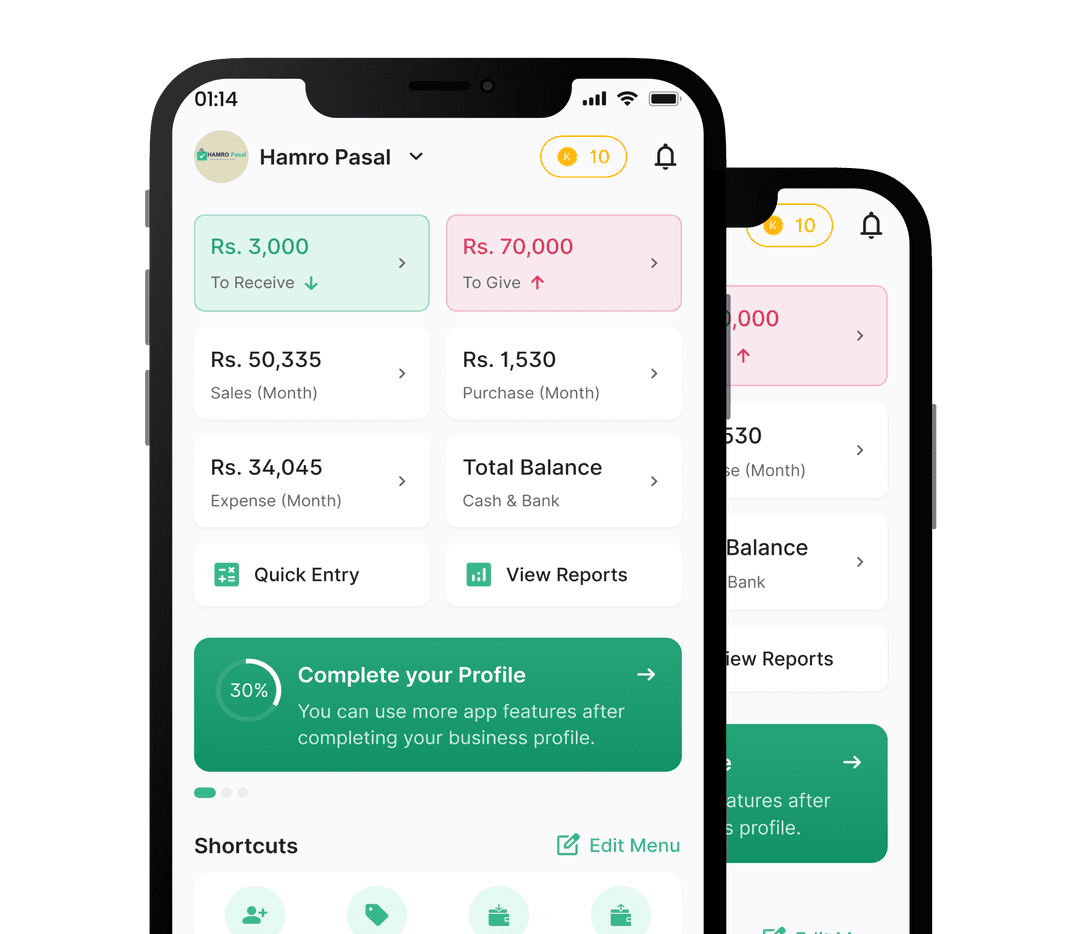
Track from that first test sale. Not in your head. Written down. Karobar lets you record sales and expenses before you register anything, so those ten sales become real data: what sold, at what price, and what it cost you.
Most first-time owners in Nepal underestimate their startup cost by a third or more. The visible costs are easy. The hidden ones sink people.
Here is a checklist. The figures are examples. Replace every one with a real quote you have obtained yourself.
| Cost | Often forgotten? | Notes |
|---|---|---|
| Rent deposit (often 3 months) | No | Usually your largest day-one payment |
| Monthly rent | No | |
| Shop fittings, shelving, counter | No | |
| Opening stock | No | Almost always underestimated |
| Working capital buffer | Yes | Cash to restock before sales come in |
| Registration and PAN | Sometimes | NPR 1,000 to 5,000 for a small firm |
| Signboard and branding | Sometimes | |
| Electricity deposit and wiring | Yes | |
| Internet, phone, QR setup | Yes | |
| Licence for your sector | Yes | Food, pharmacy and liquor all differ |
| Staff salary, months 1 to 3 | Yes | Before the business pays for itself |
| Your living costs for 6 months | Yes | The most forgotten cost in Nepal |
| Wastage, breakage, expiry | Yes | Budget for it. It is not optional |
If you spend all your capital on stock, you have nothing left to restock with when half of it sells. Shops die with full shelves and no cash. Keep at least one month’s purchasing budget aside, untouched.
If the shop cannot pay you a salary, the shop is not profitable. Your savings are paying for it, and you should know exactly how long they will last.
Do not plan to borrow your way out. Access to finance is a major problem for 40.5% of small firms in Nepal (ADB research). SME interest runs around 12.51% plus charges, and banks often want more than four rupees of security for every rupee lent. Plan to survive on what you have.
This section is short on purpose. The official sources are better than any blog, and the rules change. Use this to orient yourself, then check.
This is what most small shops choose. You will need a ward recommendation letter, your citizenship certificate, proof of business address (with the landlord’s no-objection letter if you rent), photographs, and a PAN certificate. Expect around NPR 1,000 as an application fee, a registration fee of NPR 1,000 to 5,000 depending on capital, and about NPR 200 for PAN. It takes three to seven working days.
You register online through the CAMIS portal. Reserve a name (approval lasts 35 days), upload your Memorandum and Articles of Association with shareholder documents, and pay a fee based on capital: about NPR 1,000 up to 1 lakh, NPR 4,500 for 1 to 5 lakh, NPR 9,500 for 5 to 25 lakh, and NPR 16,000 for 25 lakh to 1 crore. One shareholder is enough. A clean file takes 7 to 14 days.
| Sole proprietorship | Private limited | |
|---|---|---|
| Government fee | NPR 1,000 to 5,000 | NPR 1,000 to 16,000 by capital |
| Time | 3 to 7 working days | 7 to 14 days |
| Minimum capital | None | Usually NPR 100,000 paid-up |
| Your liability | Unlimited. Your assets are at risk | Limited to your shares |
| Credibility | Lower | Higher |
| Paperwork | Light | Annual filings, audit, board records |
| Closing it | Simple | Formal winding-up |
| Best for | A first shop, one owner, small capital | Partners, investment, big contracts |
Most single-owner shops in Nepal start as sole proprietorships and convert later if they grow. If you are unsure, register simple and revisit it when your turnover forces the question.
One thing to be clear about. Registration, PAN and tax filing are handled by the Inland Revenue Department and the Office of the Company Registrar. Karobar is a business management app. It keeps your sales, purchases, expenses, stock and customer records in order, so your accountant gets the year’s figures in one place. It does not file anything with the tax office for you.
Not sure what it covers for your business? Contact Karobar and ask.
New buyers get worse prices than established ones. That is normal and temporary, but only if you handle the first six months well.
Depending on your sector, that means the wholesale markets: Ason and New Road in Kathmandu for general goods, Kalimati for fruit and vegetables, Birgunj for imported goods. Or distributors who come to you. The gap between the first and third quote is often 10 to 15%, which on a retail margin decides your year.
The rate matters less than: minimum order size, how often they deliver and who pays, whether you can return unsold or damaged goods, and how fast they restock a fast seller. A supplier who is 2% dearer but delivers twice a week is usually cheaper, because you hold less stock.
Most suppliers start you on cash and move you to 15 or 30 days once you have proved reliable. Getting 30-day terms is worth more than a 3% discount, because your stock is then partly financed by the supplier. How to earn it is simple: pay early, every time, for the first few months, and make sure they notice.
Record every supplier and purchase in Karobar. You will see what you owe and when, so you never miss the payment that earns you better terms. And after a few months you can negotiate with numbers instead of hope.
Here is the most common pricing error in Nepali retail.
You buy an item for NPR 80. You sell it for NPR 100. You think you are making 20%.
You are not. Here is a shop selling NPR 500,000 a month at that markup:
| Line | NPR |
|---|---|
| Monthly sales | 500,000 |
| Cost of goods sold | 400,000 |
| Gross profit | 100,000 |
| Rent | (15,000) |
| Electricity, water, internet | (3,000) |
| One staff member | (20,000) |
| Transport and delivery | (4,000) |
| Miscellaneous | (3,000) |
| Stock expired or unsold (about 2%) | (8,000) |
| Credit never repaid (about 1%) | (5,000) |
| Actual profit | 42,000 |
| Less what you could earn employed | (30,000) |
| Real profit | 12,000 |
That 20% margin is really about 8% before your own time, and closer to 2% after it. This is why shops feel busy and stay poor. Three things eat the difference:
Dead stock. Goods sitting unsold are cash you already spent. A shop with NPR 100,000 of slow stock has NPR 100,000 less to trade with.
Unpaid udhaaro. Credit never recovered is not a bad debt at year end. It was a discount you gave at the moment of sale without deciding to.
Your unpaid time. Working 70 hours a week for less than you would earn employed means the business is not yet a business.
Fast-moving staples carry thin margins, and they should, because customers know those prices. Slower goods carry the real margin. Using one markup across everything leaves money on the table at one end and prices you out at the other.
Karobar lets you set purchase price, selling price, MRP and wholesale rate per item, so margin is calculated, not guessed. The product report shows which items actually make your profit. The item you sell most of is often not the one paying your rent.
Nepal has gone digital on money. In one recent month the country processed 59.26 million QR transactions worth NPR 162.58 billion (Kathmandu Post). QR volumes are up more than sixtyfold since 2020-21.
Yet most shops taking QR payments still write the sale in a paper copy at closing, if at all. Money arrives digitally, the record is handwritten. That gap is where confusion lives.
You do not need full accounting on day one. You need four things, about ten minutes a day.
| Record | How often | Why |
|---|---|---|
| Every sale | As it happens, not a daily total | Totals cannot tell you what sold, at what margin, or when you are busy |
| Every expense | The moment money leaves your hand | The NPR 200 transport and NPR 50 rickshaw vanish, and they add up |
| Credit, both ways | When it is given or taken | Who owes you, who you owe, and when each is due |
| Stock on hand | Top sellers at minimum | So you never run out of what customers come for |
What can wait: formal accounting, balance sheets, payroll systems. Those matter later, and mostly to your accountant.
Karobar covers all four. It works offline, so an entry made during a connection drop still saves. It runs in Nepali and switches between Bikram Sambat and AD dates. You can import an existing Excel sheet. And it backs up to the cloud, which matters because phones get lost and a lost copy takes the whole business memory with it.
Watch the setup: video walkthrough
It covers creating your profile, adding items with prices, and recording your first sale.
Build the habit in week one, while volume is low. Starting in month eight, with a year of gaps behind you, is much harder.
| Days | Focus | What you should have |
|---|---|---|
| 1 to 14 | Test and cost | Ten real sales. Three supplier quotes. A written startup cost, every line quoted. |
| 15 to 30 | Register and secure the shop | Registration and PAN underway. Lease signed. Suppliers chosen. Karobar set up with opening expenses. |
| 31 to 45 | Fit out and price | Shop ready. Opening stock entered with purchase and selling prices. Low-stock alerts on your top 20 items. |
| 46 to 60 | Soft open | Trading quietly. Every sale and expense recorded daily. A written credit policy. |
| 61 to 75 | Measure | First real numbers. What sells, what does not, your actual margin. Cut dead stock now. |
| 76 to 90 | Adjust and decide | Month-on-month comparison. Reorder points from real data. An honest answer to: is this paying me? |
If you open in the second half of the year, festival timing matters more than almost anything. Dashain begins on 11 October 2026 and peaks on 21 October. Tihar runs to Bhai Tika on 11 November. Together they are the biggest retail event of the year, worth roughly NPR 200 billion (source). Stock ordering has to happen weeks ahead.
Laxmi Puja, on 8 November 2026, is when Nepali businesses traditionally open new account books. That makes it the natural moment to start keeping records properly.
The daily rhythm is simple: enter sales and expenses each evening, check your cash against the drawer, and once a week look at three reports. What sold, what is owed to you, and what stock is low. Fifteen minutes a week puts you ahead of most shops on your street.
The trigger is not "I am busy." It is one of two things. You are turning away customers or closing early because you cannot cover the hours. Or you are spending so long on tasks worth NPR 100 an hour that you have no time for the ones worth NPR 1,000.
A staff member on NPR 20,000 a month costs more than NPR 20,000. Plan for the extras:
| What you actually pay for | Typical cost | When |
|---|---|---|
| Monthly salary | NPR 20,000 | Every month |
| Dashain or festival bonus | About one month’s salary | Once a year |
| Training before they are useful | 2 to 4 weeks of salary | Month 1 |
| Mistakes while learning | Varies, budget for some | Months 1 to 3 |
| Tea, snacks, allowances | NPR 1,000 to 2,000 a month | Every month |
| Realistic first-year cost | About 13 to 14 months of salary |
Once someone else sells while you are away, you need to know what was sold without watching it happen. This is where paper stops working. Not usually theft, but drift and gaps nobody can reconstruct later.
Karobar handles this with staff roles. Your employee records sales and checks stock without seeing your margins, cash position or supplier prices. Every entry is attributed. You can check the day’s takings from your phone and reconcile the drawer in under a minute. If you open a second outlet, multi-business support keeps the books separate under one account.
The businesses that survive their first year in Nepal are rarely the ones with the best idea. They are the ones whose owners knew their numbers early enough to act on them.
Start free with Karobar. Record your first sale today, in Nepali, on your phone, with or without internet. Over 3 lakh Nepali businesses already do.
Still deciding if it fits your shop? Get in touch and ask.
How much does it cost to start a small business in Nepal?
Registration is minor: NPR 1,000 to 5,000 for a sole proprietorship including PAN, or NPR 1,000 to 16,000 for a private limited depending on capital. The real cost is rent deposit, fittings, opening stock and working capital, which for a small shop usually runs from a few lakh upwards. Budget separately for your own living costs for six months.
Do I need to register before I start selling?
To trade legally, take a commercial lease, open a business bank account or deal with most wholesalers, yes. But you can and should test your idea with small informal sales first. Validating demand is the point of section 1.
Sole proprietorship or private limited company?
A sole proprietorship is faster, cheaper and simpler to close, but you are personally liable for business debts. A private limited protects your personal assets and carries more credibility with suppliers and lenders, but needs more paperwork. Most small retail shops start as sole proprietorships.
How long does registration take in Nepal?
Three to seven working days for a sole proprietorship with complete documents. A private limited through the CAMIS portal usually takes 7 to 14 days from name reservation to certificate.
Can I run my business from my phone in Nepal?
Yes. Recording sales, tracking customer credit, monitoring stock and reviewing reports can all be done from a phone. Karobar works offline and syncs when you reconnect. Registration, PAN and tax filing are separate processes handled through IRD and OCR.
Share this article:
3 mins read
The Ultimate Guide to Choosing Accounting Software

3 mins read
Are you a content creator who loves making engaging videos? Do you have creative ideas that can insp

8 mins read
Which business app suits a Nepali shop? Compare Nepali language, Bikram Sambat, udhaaro tracking, of
Download Karobar app & digitize your business management